
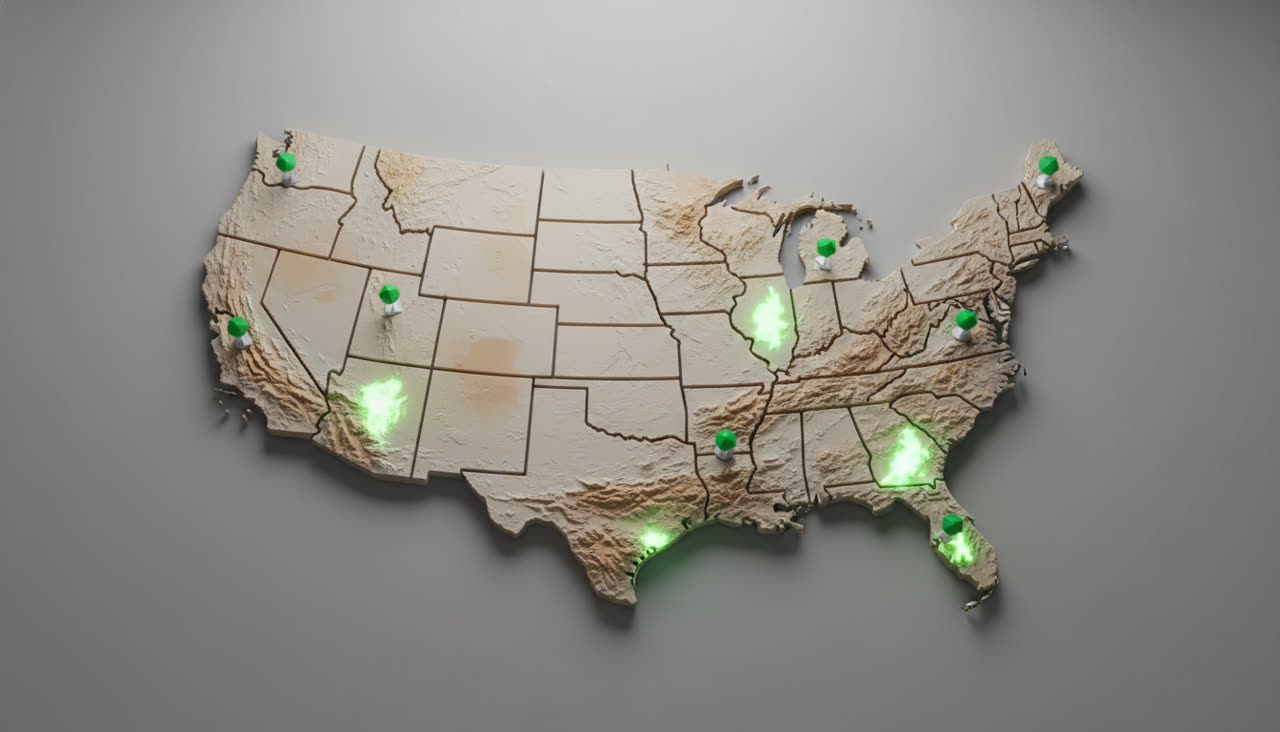
It's easy to assume cannabis legalization is a settled story — that the map is drawn and we're just waiting on the federal government. But the state-by-state expansion that built this industry is far from over. As of early 2026, recreational cannabis is legal in 24 states plus Washington, D.C., and Guam, with medical marijuana permitted in 42 states. And several more states are poised to potentially join the adult-use column this year.
For an industry projected to reach roughly $47 billion in 2026, every new state is a fresh land grab — and a fresh test of which operators have learned to launch well.
The five to watch
Five states stand out as legalization candidates in 2026: Florida, Hawaii, New Hampshire, Pennsylvania, and Virginia. Each tells a different story about how legalization is unfolding.
- Florida is the giant in the room. With its enormous population and a large existing medical market, an adult-use Florida would instantly become one of the most valuable cannabis markets in the country.
- Pennsylvania has seen genuine legislative momentum, and it's surrounded by legal neighbors capturing its residents' dollars — a powerful incentive to stop exporting tax revenue across state lines.
- Virginia legalized possession years ago but never fully stood up a retail market; closing that gap has been a recurring battle.
- New Hampshire, an island of prohibition in a legal New England, faces the same cross-border pressure as Pennsylvania.
- Hawaii has long had medical cannabis and has repeatedly flirted with adult-use.
None of these is a sure thing — legalization lives or dies on each state's particular politics, and predictions in this space have a long history of disappointment. But the direction of travel is unmistakable.
Why cross-border pressure keeps winning
The most reliable engine of legalization isn't ideology; it's economics. When a state's residents simply drive across the border to buy legal cannabis, that state watches its tax revenue and jobs flow to a neighbor while still bearing the enforcement costs. That math has flipped legislatures before, and it's exactly the pressure bearing down on Pennsylvania and New Hampshire.
Nothing concentrates a legislature's mind like watching its own residents spend their cannabis dollars in the state next door.
What it means for the industry
For operators, each new market is opportunity layered with uncertainty — licensing regimes, tax structures, and rollout timelines all vary, and a botched launch can be as damaging as a missed one. The companies best positioned to win new states are the disciplined, experienced ones that have learned to open profitably rather than just quickly. After years of overbuilding, that hard-won operational discipline is exactly what new-market expansion rewards.
For consumers, more legal states means more access, more competition, and — over time — better pricing as markets mature. New York's own trajectory, from a rocky start to the fastest-growing market in the country, is a preview of what a new state's first few years can look like: messy at first, then increasingly competitive. You can see what a maturing market offers shoppers by comparing cannabis deals and dispensaries on High Today.
The medical-to-adult-use pipeline
One pattern worth understanding is how often adult-use legalization is really an upgrade of an existing medical market rather than a from-scratch creation. Florida, Hawaii, and Virginia all have established medical programs with infrastructure, operators, and patients already in place. That matters because it lowers the activation energy: the cultivation, the retail, and the regulatory machinery already exist, so flipping to adult-use is less a leap than a step. It also means the incumbents in those medical markets stand to benefit first when the broader market opens.
That dynamic shapes who wins. In a state converting from medical to adult-use, the operators already serving patients have a head start on real estate, licensing relationships, and brand recognition. New entrants can still break in, but the smart money watches the existing medical players closely whenever a state inches toward recreational. For consumers in these states, the upside is that an adult-use launch built on a mature medical market tends to come online faster and more smoothly than a market starting from nothing — fewer of the supply shortages and licensing snarls that plagued some first-wave states.
It's also worth watching how the federal picture interacts with these state fights. With rescheduling underway and the 280E tax burden lifting, the economics of opening in a new state look dramatically better than they did even a year ago — which could embolden both operators to invest and legislators to act, knowing the businesses they license will be more viable. A friendlier federal backdrop doesn't legalize anything at the state level, but it changes the math everyone is running, and that can tip close votes. The states that move in 2026 won't do so because of Washington, but they'll do so in a Washington environment that finally makes legal cannabis look like a normal, taxable, bankable industry rather than a federal liability.
For New York specifically, more legal states is a quiet positive even though it adds competition. A bigger national market normalizes cannabis further, pulls more brands and capital into the industry, and strengthens the case for the federal reforms — banking, interstate commerce — that New York operators want. A rising legal tide tends to lift the whole sector, even as individual states compete for their own residents' dollars.
The bottom line
The legalization map still has room to grow, and 2026 could add some of the biggest pieces yet — Florida above all. Whether all five of these states move this year is genuinely uncertain, and history counsels patience. But the underlying logic — cross-border revenue loss, public support, and the steady normalization of cannabis — keeps pushing in one direction. The federal endgame gets the headlines, but the state-by-state expansion is still where the market physically grows, one new legal storefront at a time.