
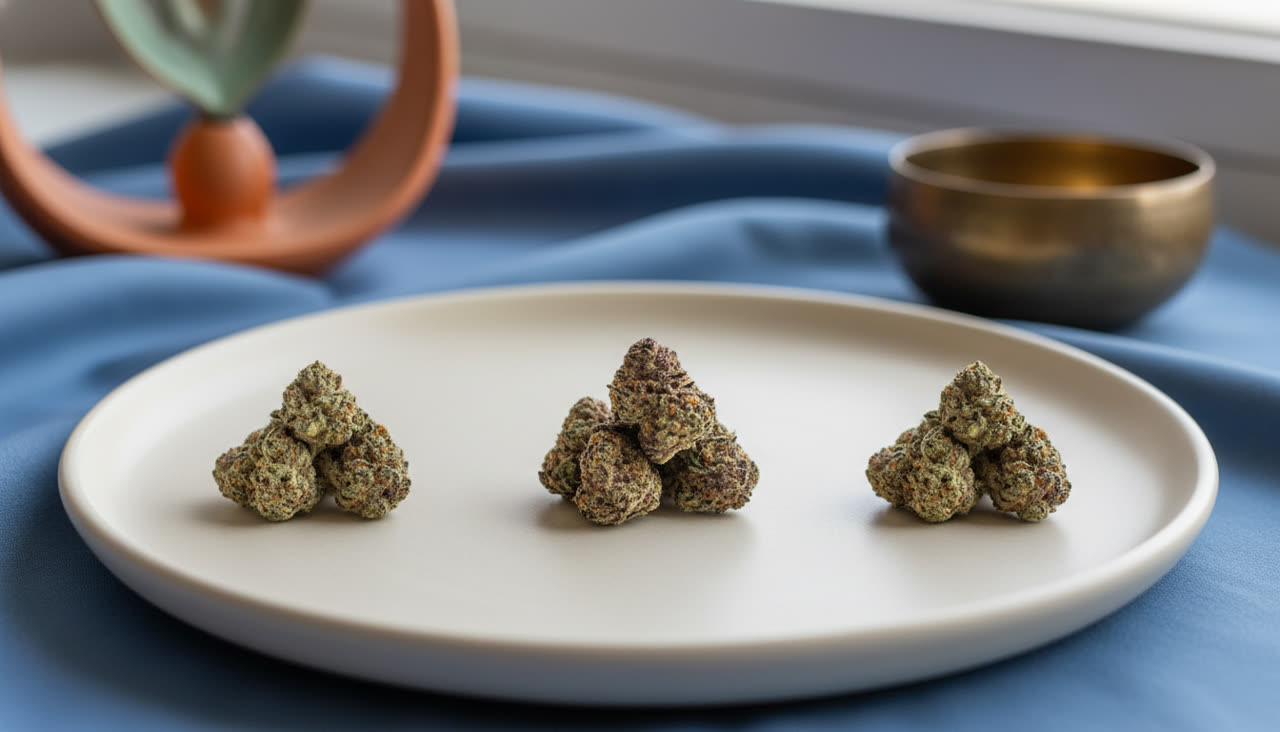
Walk into any dispensary and the very first choice you're asked to make is indica, sativa, or hybrid. It's the organizing principle of nearly every menu, the first question every budtender asks, and the foundation of how most people talk about weed. It's also — by the standards of modern cannabis science — more of a useful shorthand than a reliable prediction. This guide explains what the labels actually mean, what they don't, and how to use them to shop smarter in New York.
The quick answer
If you remember nothing else: indica and sativa describe the plant's physical structure and lineage, not a guaranteed effect. The popular rule of thumb — indica relaxes, sativa energizes, hybrids land in between — is a decent starting hypothesis, but the real driver of how a product makes you feel is its chemistry: THC, CBD, and especially terpenes. Here's the cheat sheet:
| Type | Plant & lineage | Traditional reputation | Often associated with | The reality check |
|---|---|---|---|---|
| Indica | Short, bushy, broad leaves | Relaxing, sedating ('in-da-couch') | Evening, rest, body-heavy calm | A 'rule of thumb,' not a guarantee |
| Sativa | Tall, lanky, narrow leaves | Energizing, uplifting, cerebral | Daytime, focus, creativity, social | Effects vary widely by chemotype |
| Hybrid | A cross of both | 'In between' / leans one way | Almost everything on the shelf today | The label tells you little on its own |
Where the terms actually come from
The words describe botany. Cannabis indica plants are traditionally short and bushy with broad leaves; Cannabis sativa plants are taller and lankier with narrow leaves. These were real distinctions for the farmers and botanists who named them — descriptions of how the plant grows, originally tied to the regions it came from.
What they were never designed to do is predict your high. That association — indica equals sleepy, sativa equals speedy — came later, as a marketing and consumer shorthand. It caught on because it's simple and because it's broadly true often enough to feel reliable. But 'often enough' is doing a lot of work in that sentence.
Why almost everything is a hybrid now
After decades of cross-breeding, the pure-indica and pure-sativa plants of legend are mostly gone from dispensary shelves. Nearly everything you'll buy today is a hybrid — which is why menus label things 'indica-dominant' or 'sativa-dominant' rather than one or the other. The famous modern strains prove the point: Runtz and Gelato are both hybrids whose effects come from their specific genetics, not a tidy category.
The science: why the labels mislead
Here's what two decades of watching this market — and a growing body of research — make clear: the indica/sativa label is a poor predictor of effects. Two plants both sold as 'indica' can feel completely different, and a 'sativa' can put you to sleep. The reason is that effect is governed by a plant's chemotype (its actual chemical makeup), not its morphology (its shape). Scientists increasingly prefer to talk about chemovars — varieties defined by their cannabinoid and terpene content — precisely because indica/sativa says so little about what's inside.
What actually determines the effect
Three things matter far more than the category on the label:
- THC is the primary intoxicating compound and the main driver of potency. But as we explain in our guide on why THC percentage isn't everything, more THC mostly means more intensity, not a better experience.
- CBD is non-intoxicating and can soften and balance the high. A little CBD alongside THC often makes for a more even, less heady experience.
- Terpenes — the aromatic compounds behind cannabis's smell — shape the character of the effect, often more noticeably than a few points of THC. This is the heart of the entourage effect.
Terpenes: the better predictor
If you want a clue about how a product will feel, read the terpenes, not the category. A few common ones and the feelings they're popularly associated with:
| Terpene | Aroma | Popularly associated with |
|---|---|---|
| Myrcene | Earthy, musky | Relaxation, the classic 'indica' couch-lock feel |
| Limonene | Citrus | Bright, uplifted, mood-boosting |
| Caryophyllene | Peppery, spicy | Calm, body comfort |
| Pinene | Pine | Alertness, clarity |
| Linalool | Floral lavender | Calm, winding down |
Notice that myrcene — not the word 'indica' — is what tends to track with that heavy, relaxing feeling. Learn five terpene names and you'll out-shop anyone relying on the category label alone.
How to use indica vs. sativa when you shop in New York
The labels aren't useless — they're the beginning of the conversation, not the end. Use them like this:
- Start with the experience you want, not the category. Tell the budtender whether you're after relaxation, sleep, focus, energy, creativity, social ease, or relief.
- Ask for the terpene profile. A good licensed shop can tell you a product's dominant terpenes and what they tend to feel like.
- Mind the THC percentage, especially if you're newer — lower is wiser.
- Read the whole label. New York requires lab-tested products with cannabinoid content listed; use it. Our guide on reading a dispensary label breaks down exactly what to look for.
Quick goal-based starting points
- Sleep: look for myrcene-forward, higher-THC indica-leaning products — but verify with the terpenes.
- Energy / daytime: limonene- or pinene-forward, often sativa-leaning, ideally moderate THC.
- Focus / creativity: pinene-forward, balanced THC, sometimes with a little CBD.
- Social: balanced hybrids, lower-to-moderate THC, or a low-dose edible or drink.
- Relief without heaviness: balanced THC:CBD products.
Common myths, cleared up
- 'Sativa can't make you sleepy.' It can — a high-myrcene 'sativa' may be more sedating than a bright 'indica.'
- 'Indica is always stronger.' Strength is about THC and your tolerance, not the category. See the strongest strains of 2026.
- 'Hybrid means balanced.' Hybrids can lean hard in either direction; the label alone won't tell you which.
- 'The name tells you the effect.' A strain name is branding. The lab-tested profile tells the truth.
The bottom line
Indica, sativa, and hybrid are a convenient on-ramp — they hint at a product's lineage and likely lean, and they're a fine way to begin a conversation with your budtender. But they are not a reliable map of how you'll feel. The real predictors are THC, CBD, and terpenes. Learn to read those, start low, and you'll get far more consistent results than chasing the category alone. To put it into practice, compare deals across licensed dispensaries and browse New York brands by their full profiles, not just their labels. Educational only — not medical advice. For adults 21+.