
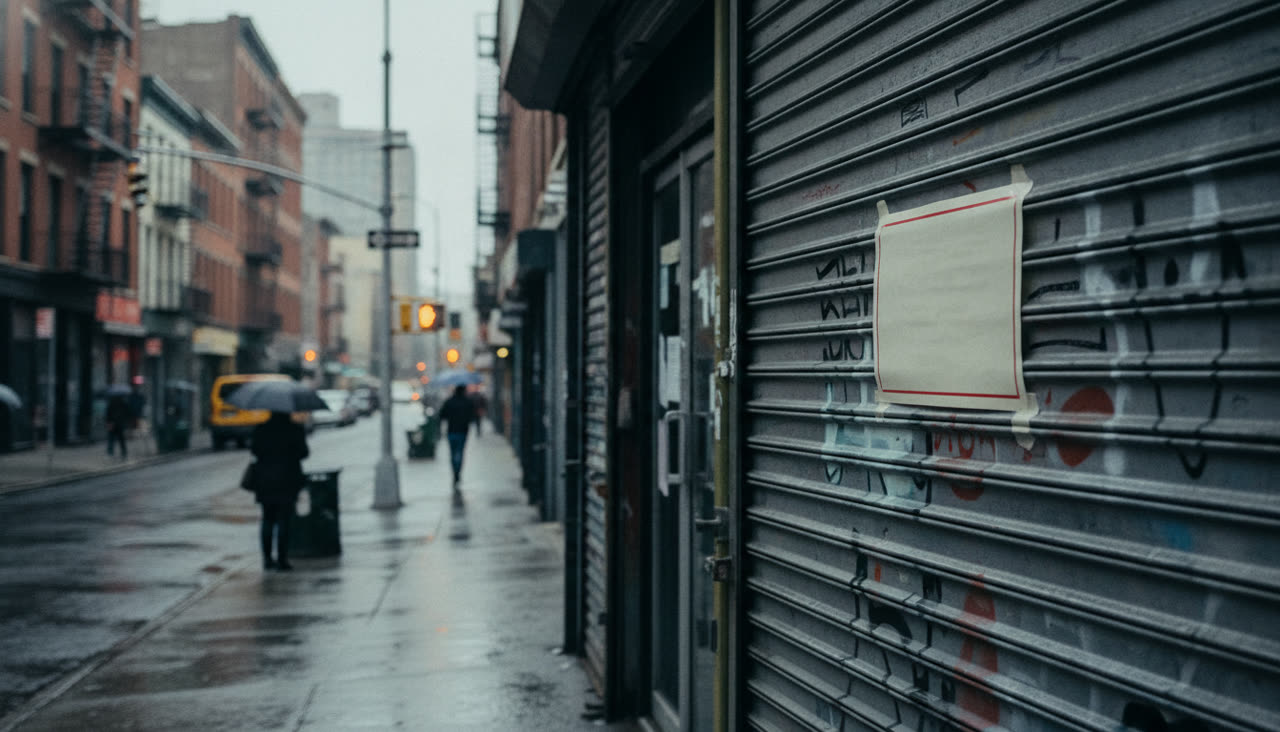
New York keeps sealing unlicensed cannabis storefronts, and the cases now stretch well beyond New York City. This story explains how a padlock works, from the legal authority to the landlord's role, using two upstate cases. For the statewide numbers, see our companion piece on how many shops New York has shut.
A Rochester case, step by step
On April 16, 2026, OCM's Enforcement and Investigations Division and the Rochester Police Department carried out inspections and search warrants at two smoke shops and a storage site they shared, according to Spectrum News and WHEC. The shops were Unique Smoke Shop on Lyell Avenue in Rochester and Mr. Starlight Smoke Shop on Chestnut Ridge Road in Chili.
Investigators reported seizing more than 147 pounds of flower, 5,216 vape devices, 5,022 edible packages and 1,998 pre-rolls, which they valued at more than $1.3 million. The operator was served Notices of Violation and Orders to Seal, and both storefronts were padlocked. The case shows the usual sequence: an investigation, an inspection or warrant, seizure, a Notice of Violation that starts an administrative hearing, and an Order to Seal that closes the business.
The legal toolkit behind a padlock
Most of these powers date to the state budget enacted in April 2024. As the Appellate Division described in a June 2026 ruling, that law let counties and cities adopt their own inspection laws for businesses not on OCM's licensee directory, and amended the city code so the New York City Sheriff could inspect places selling cannabis without a license.
OCM's law enforcement page lays out the details:
- One-year padlocks. An emergency padlock stays in effect for one year.
- Criminal penalty for tampering. Removing or damaging a padlock is a Class A misdemeanor for obstructing governmental administration.
- Fast hearings for local laws. Local padlock laws must provide a court hearing within three days of an emergency padlocking and a decision within four days after that hearing.
- Landlord pressure. Under Real Property Actions and Proceedings Law section 715-a, a landlord who gets a notice must start proceedings against the tenant within five business days. If the landlord does not cooperate, the enforcement agency can bring the case itself and seek penalties from the landlord.
The largest seizure on record
On August 3, 2026, OCM said a months-long investigation led by the Greece Police Department produced the largest illicit seizure in the agency's history: more than $17 million in cannabis, cannabis products and processing equipment from several illegal businesses in Greece, outside Rochester. Officials said the products were bound for Central New York.
OCM used the case to make a health point. Seized gummies were labeled at 300 mg of THC each, compared with New York's legal limit of 10 mg per gummy, and candy bars were labeled at 10,000 mg, compared with a 100 mg legal limit. Dr. Junella Chin, OCM's chief medical officer, said the products "look like candy, are not in child resistant packaging, are untested." Executive Director John Kagia said "strong partnerships are essential to maintaining the integrity of New York's regulated cannabis market."
New York City's separate track
In the city, enforcement runs mainly through Operation Padlock to Protect, which Mayor Eric Adams launched in May 2024. It pairs the Sheriff's Office with the NYPD and the Department of Consumer and Worker Protection. The "more than 750" figure often repeated about it, including in an earlier version of this story, came from an August 2024 city announcement. By December 2024, the Sheriff put the total at about 1,300 shops.
What it means for the legal market and shoppers
Every sealed storefront removes a competitor that skips testing, packaging rules and taxes. OCM data presented at the October 1, 2026 Cannabis Control Board meeting show the licensed side still adding stores: 735 adult-use dispensaries recorded sales in September, up from 685 in June, with average annualized sales of about $2.7 million per store.
Shoppers can avoid the problem entirely by buying from licensed stores, which verify age and sell tested, labeled products. Compare deals at licensed dispensaries on High Today.
Update: October 2026
Since this story ran in July, the Greece seizure became OCM's largest ever, and the agency said it had padlocked 674 illicit shops statewide as of August 3. The inspection powers behind these cases are also on firmer legal ground after the Appellate Division lifted an injunction on warrantless inspections of licensed hemp retailers in June.
One piece of follow-up legislation has stalled. S9924, sponsored by Sen. Jeremy Cooney with an Assembly companion from Majority Leader Crystal Peoples-Stokes (Post-Journal), would write OCM's inspection and seizure procedures into state law. Its most recent recorded action was a May 12, 2026 committee vote sending it to the Senate Codes Committee. What to watch next: further OCM enforcement releases, and whether the hemp-shop plaintiffs take their case to the Court of Appeals.
Cannabis products are for adults 21+.