
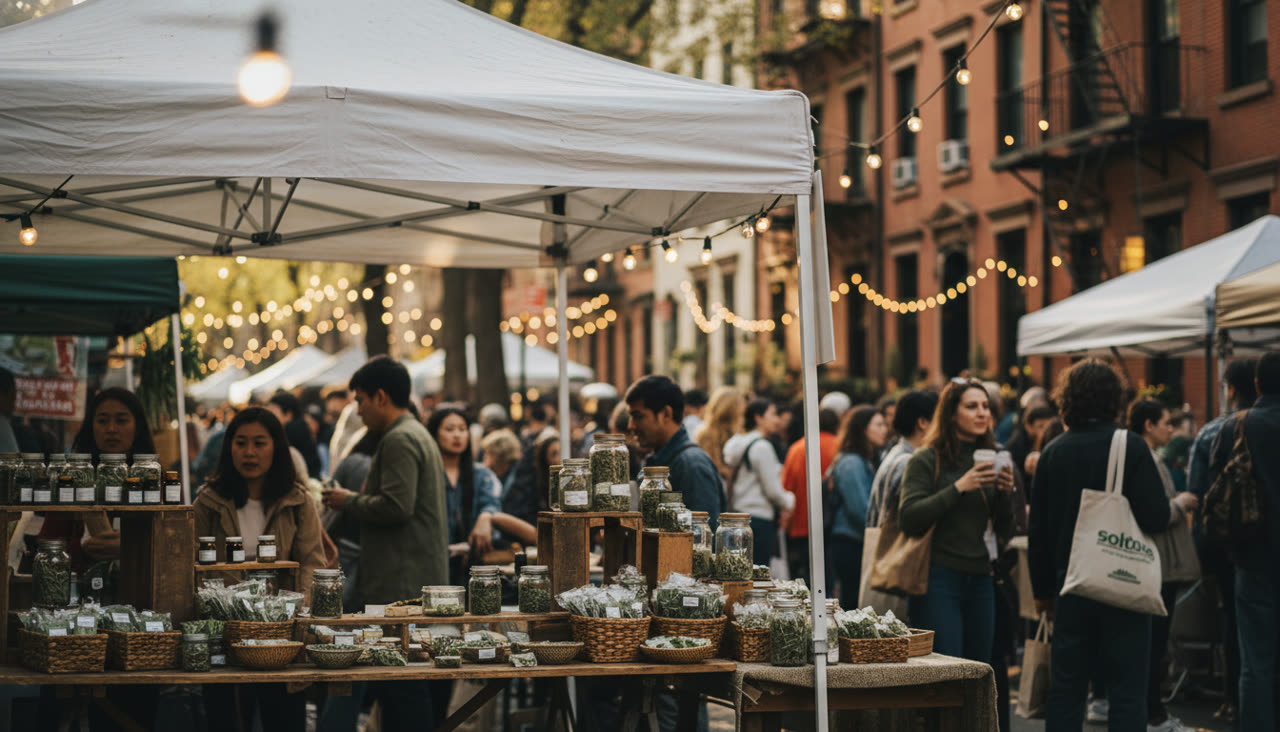
Every mature cannabis market eventually figures out that retail can't live inside four walls forever. California has its events. Colorado has its festivals. Now New York is catching up. On May 4, the Office of Cannabis Management opened applications for Cannabis Showcase Events — a framework that lets licensed dispensaries sell at temporary off-site locations like pop-ups, public markets, and farmers' markets. For an industry that has been confined to brick-and-mortar storefronts since legal sales began, this is a meaningful expansion of where and how legal weed can reach people.
I've watched events become a make-or-break channel in other states, and the pattern is consistent: they are where small brands get discovered and where curious, casual consumers take their first comfortable step into the legal market. New York just gave its operators that tool. The question now is who uses it well.
How the events actually work
The structure is deliberate. A licensed retailer applies for and holds the event permit, and that retailer is the only party allowed to ring up sales. Cultivators and processors can participate — they can display product, talk to customers, build brand awareness — but they cannot sell directly or hand out samples. Every transaction flows through the licensed retail system.
That design solves a real problem. It lets the small growers and craft processors who can't afford their own storefront get face time with consumers, while keeping the state's tax-and-track compliance intact. In a market where shelf space is fiercely contested, a weekend in front of the right crowd can be worth more than months of digital advertising.
The fine print that will separate winners from headaches
This is where two decades of watching regulators teaches you to read carefully. The rules are workable, but they are not casual:
- Events can run up to 14 consecutive days, and any single venue is capped at 45 event-days per calendar year.
- Applicants must secure municipal approval first, then file with OCM at least 45 days before the event.
- Venues must sit at least 500 feet from a school and 200 feet from a place of worship.
- Attendees must be 21 or older. No on-site consumption, no free samples, no giveaways.
None of these are dealbreakers, but together they reward operators who plan early and treat compliance as a discipline rather than an afterthought. The 45-day lead time alone means the operators who win this summer are the ones already filing paperwork now. I've seen too many businesses treat a new opportunity as a sprint when the regulation clearly rewards the marathoners.
Why this matters more for New York City than anywhere else
Density is the whole story here. New York City is the densest, highest-foot-traffic retail environment in the country, layered with one of the world's great tourism economies. A well-placed pop-up in the right neighborhood — or a recurring booth at an established public market — puts a licensed dispensary in front of thousands of potential customers who might never walk past its actual storefront.
A pop-up isn't just a sales channel. It's a discovery engine. The shopper who tries your product at a Saturday market becomes the regular who orders all winter.
There's also a competitive dimension that the legal market badly needs. For years, the unlicensed shops owned the tourist corridors and the convenient corners. Showcase events give licensed operators a sanctioned, mobile way to reclaim that visibility — to meet consumers where they already are instead of waiting for them to find a compliant store. Every legal sale at a market is a sale that didn't go to the gray market.
The strategic read for operators and consumers
If you operate in New York, here's my advice: don't treat showcase events as a novelty. Treat them as a customer-acquisition channel with a measurable cost and a measurable payoff. Pick venues that match your brand. Train staff for the open-air environment. And use the event to drive people back to your permanent locations and your online presence, because the lifetime value of a customer dwarfs the margin on a single market sale.
For consumers, the practical upside is more access and more discovery — a chance to meet brands and budtenders in a relaxed setting rather than a transactional one. As these events spin up across the state, the easiest way to keep track of which licensed retailers are active and what they're charging is to compare the day's cannabis deals and browse the dispensary directory on High Today. You can also explore which brands are showing up at markets near you.
A blueprint other markets will copy
What New York is doing here isn't novel in concept — California and Colorado normalized cannabis events years ago — but the structure matters, and New York's version is unusually retail-anchored. By routing every sale through a licensed dispensary while letting cultivators and processors showcase product, the state threads a difficult needle: it gives small brands oxygen without creating a parallel, harder-to-track sales channel. If it works, expect other young markets to borrow the framework.
The risk, as always, is over-regulation choking the opportunity before it matures. A 45-day lead time, municipal sign-off, and tight siting rules are reasonable on paper, but they add friction that favors larger, better-resourced operators over the small businesses these events are partly meant to help. The operators who succeed will treat events as a repeatable system — standardized permits, trained staff, a venue playbook — rather than one-off experiments. I'd also watch how municipalities respond; a few high-profile, well-run events will do more to win local buy-in than any amount of lobbying. Get those early wins right, and showcase events could become one of the most effective customer-acquisition tools in the state. Get them wrong, and they'll be remembered as paperwork nobody bothered with.
New York's market spent its first years fighting to survive. Tools like this are what a market looks like once it starts to thrive. The regulation is live, the rules are knowable, and the operators who move first — carefully — are the ones who will own the summer.