
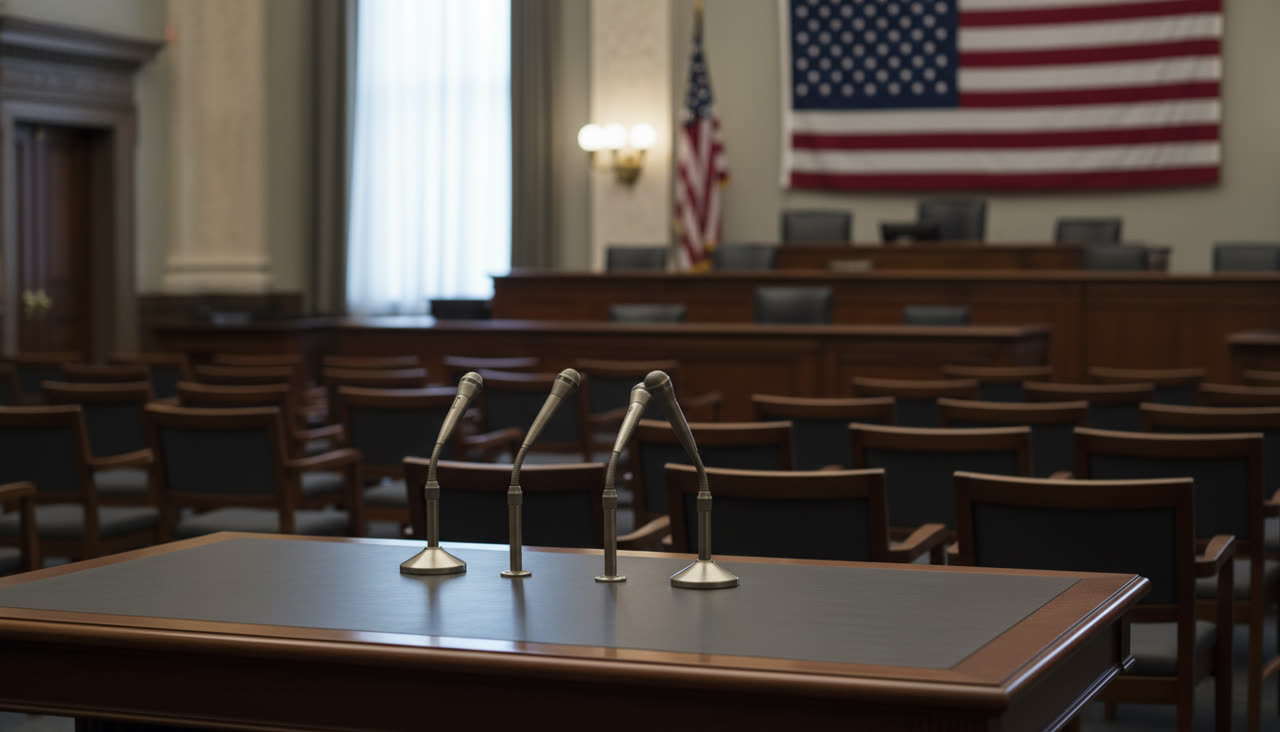
Update, June 30, 2026: The hearing opened yesterday in Arlington, Virginia, and it began with a twist. The Justice Department did not simply present the rescheduling proposal, it openly backed it. A DEA attorney told the court the government supports moving marijuana to Schedule III and would prove cannabis has a currently accepted medical use, then called its first witness, FDA scientist Dr. Dominic Chiapperino, who directs controlled-substance review at the agency's drug-evaluation center. The anti-rescheduling participants spent the day trying to poke holes in that case. Only about 25 people watched in the DEA's small Arlington courtroom, and the proceeding is not being livestreamed. It runs through July 15, with a recess on July 3 and a return on July 6, after which the judge will send a recommendation to the DEA Administrator for the final decision. We will keep this updated.
Mark June 29 on your calendar. That's the day the Drug Enforcement Administration opens the administrative hearing that could finish what the federal government started earlier this year: moving marijuana, comprehensively, from Schedule I to Schedule III. The hearing is set to conclude by July 15, and after two decades of watching "imminent" federal reform evaporate, I can tell you this is the most consequential cannabis proceeding in a generation.
The stakes are why both sides are showing up in force.
How we got here
Earlier in 2026, the Justice Department took the historic step of reclassifying FDA-approved and state-licensed medical cannabis to Schedule III — the first federal reclassification of the plant since 1971. That move, momentous as it was, left the bigger question open: what about marijuana generally? The June 29 hearing is the legally required process for answering it.
This is not a vote or a quick rule change. It's an administrative hearing where evidence is presented, witnesses are heard, and the record is built that any broader rescheduling must stand on. It's deliberate, it's procedural, and it's exactly the kind of process that can be appealed and litigated — which is why the timeline matters.
Both sides are lining up
What makes this hearing different from past false starts is that the fight is now fully joined. Reform advocates and prohibitionists alike have filed formal notices of intent to participate.
On the reform side, the National Organization for the Reform of Marijuana Laws (NORML) filed to participate, arguing that cannabis consumers — not just industry and government — deserve a seat at the table. That's a meaningful framing: for most of cannabis history, the people who actually use the plant had no voice in the policy that governed them.
On the other side, Smart Approaches to Marijuana (SAM), the country's most prominent prohibitionist group, also filed to participate, with its leadership vowing not to "sit on the sidelines." Their involvement guarantees the hearing will be contested rather than a formality.
For the first time, the people who use cannabis are demanding a seat at the federal table — and the opposition is showing up to fight them for it.
Why it matters to the whole industry
The practical consequences of a full move to Schedule III are enormous. The biggest is tax: Section 280E, which bars cannabis businesses from deducting ordinary expenses, has functioned as a silent killer of otherwise-healthy operators, pushing effective tax rates above 70%. A broader reclassification would extend relief well beyond the medical operators already covered.
Beyond taxes, rescheduling eases research — finally letting scientists study the plant without navigating a Schedule I bureaucracy — and it shifts the entire risk calculus that has kept banks and institutional capital at arm's length. Sentiment follows signals like this, and a full Schedule III move would be the loudest signal yet that cannabis is no longer a federal pariah.
For New York operators and consumers, a friendlier federal backdrop means healthier businesses and, over time, more competition and better value. You can already watch how competitive the legal market has become by comparing the day's cannabis deals across licensed New York dispensaries.
The realistic read
I'll temper the optimism, because I've earned the caution. An administrative hearing is not a finish line; it's a milestone on a road that includes public comment, a final determination, and near-certain legal challenges. A full Schedule III outcome could still take months to finalize, and the opposition will contest every step.
But here's what's different this time: the federal government has already conceded the medical legitimacy of cannabis. That concession can't be un-made, and it hollows out the intellectual case for keeping marijuana on Schedule I. The June 29 hearing is where that argument gets made on the record, in front of the agency that has resisted it for fifty years.
What to actually watch for
If you want to read the tea leaves, focus on three things. First, the tone of the proceeding — does the DEA treat full Schedule III as a near-certainty to be implemented, or as a genuinely open question to be relitigated? Second, the witnesses and evidence on the medical-use question, since the entire legal foundation of Schedule I rests on the claim that cannabis has "no accepted medical use" — a claim the government has already undercut by rescheduling medical products. Third, the timeline signals: an administrative hearing that wraps cleanly by mid-July keeps momentum alive; procedural delays would be the tell that this drags into 2027.
It's also worth watching who the opposition leans on. Prohibitionist groups will press public-health and youth-access arguments, and how persuasively the agency engages them will hint at where it's headed. None of this will be decided in a single dramatic moment — administrative law rarely is — but the contours that emerge over those two-plus weeks will tell seasoned observers a great deal about the likely outcome and how hard it will be challenged afterward.
It's also worth keeping perspective on what a Schedule III move does not do, because the gap fuels a lot of confusion. Even full rescheduling would not federally legalize adult-use cannabis, would not automatically free the thousands still incarcerated on cannabis charges, and would not by itself open the banking system or interstate commerce. Schedule III is a profound shift in posture and a massive practical win on taxes and research — but it is a step on a longer road, not the destination. Understanding that distinction matters, because the temptation after a big win is to assume the fight is over. It isn't. The advocates who have pushed this for decades know that each milestone tends to reset expectations rather than satisfy them, and that the work of full normalization — expungement, banking, interstate trade, descheduling altogether — continues well past June 29.
Watch the hearing closely. Whatever comes out of it — a clear path to Schedule III or another round of delay — will set the tone for the cannabis industry's next several years. After two decades of waiting, the endgame is finally in view.