
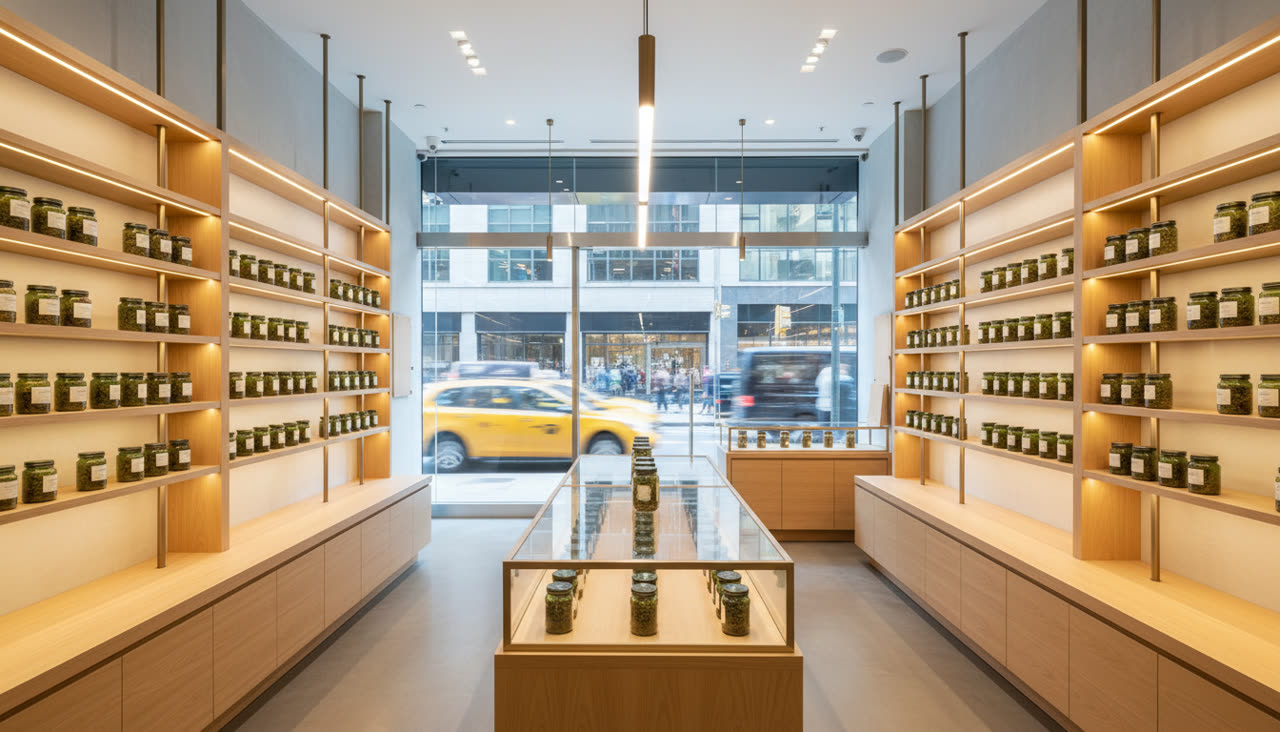
Numbers finally tell the story New York's cannabis advocates have been promising for half a decade. The state has crossed $3.3 billion in cumulative adult-use sales and surpassed 600 licensed dispensaries, with Pure Blossom on Manhattan's Upper West Side recognized as the 600th to open its doors. Governor Hochul marked the milestone as proof that the Marihuana Regulation and Taxation Act is delivering — and for once, the celebration is backed by data rather than hope.
I want to put this in context, because anyone who covered this market in 2022 and 2023 remembers a very different mood. The rollout was, to put it charitably, painful. Litigation tangled the licensing process. Unlicensed smoke shops multiplied faster than anyone could count, undercutting the handful of legal operators who'd bet everything on doing it right. The narrative was failure. So when I say New York is now the fastest-growing cannabis market in the country, growing at roughly 73.8% year over year, understand how remarkable that reversal is.
From near-disaster to national leader
The state logged more than $553 million in adult-use sales year-to-date through April, with average daily sales climbing month over month. That kind of acceleration doesn't happen by accident, and it doesn't happen because demand suddenly appeared — the demand was always there, much of it captured by the gray market. What changed is that the legal channel finally got large enough, convenient enough, and competitive enough to win that demand back.
Two forces drove the turnaround. First, the licensing pace picked up dramatically, putting real storefronts in real neighborhoods. Six hundred dispensaries is not a pilot program; it's an industry. Second — and this is the part outsiders underestimate — the state got serious about enforcement.
Enforcement was the unglamorous engine of growth
Here's a truth I've watched play out in every legal market: you cannot build a healthy licensed industry while an unlicensed one operates next door with lower prices and no compliance costs. New York learned that lesson the hard way and then acted on it. The state reported 2,017 enforcement actions in 2025, shutting 579 illicit storefronts, padlocking 581 locations, and seizing more than $20 million in illicit products — a sustained campaign to push sales toward licensed, tested cannabis.
Every unlicensed shop that closes is a customer who has to find a legal one. Enforcement isn't a side quest — it's the growth strategy.
That enforcement matters for consumers in a way that's easy to overlook. Product sold in a licensed New York dispensary is tested for potency and contaminants and tracked from seed to sale. The unlicensed stuff isn't. As the legal market expands and the gray market contracts, more New Yorkers are getting cannabis that's actually been verified. You can see how crowded and competitive the legal field has become by browsing the dispensary directory or comparing live cannabis deals on High Today.
What 600 dispensaries means for the market's next phase
Scale changes the game. When a market has a few dozen stores, every operator enjoys a kind of scarcity premium. When it has 600, the dynamics shift toward competition — on price, on selection, on service, and on brand. That's healthy. It's also where the next round of winners and losers gets decided.
For operators, the message is that the land-grab phase is ending and the operate-well phase is beginning. The dispensaries that thrive from here won't be the ones that simply got a license; they'll be the ones that nail merchandising, build loyal customers, and differentiate on experience. We're already seeing that maturity in how aggressively shops compete on daily deals — a sign of a market moving from scarcity to genuine choice.
For consumers, more competition is unambiguously good news. More stores mean shorter trips, better selection, and sharper pricing. The spread between the best and worst price on the same product can be substantial, which is exactly why price comparison has become part of the savvy New York shopper's routine. Checking the day's deals and the brands on offer before you buy is the difference between paying retail and paying smart.
The road ahead
New York isn't finished — there are still supply imbalances, still licensing backlogs, still neighborhoods underserved by legal retail. But the trajectory is unmistakable. A market that was written off two years ago is now the national pace-setter, and it's doing it with an equity-focused licensing structure — 56% of licenses have gone to Social and Economic Equity applicants, a majority of them women- and minority-owned — that much of the industry is watching closely.
What still needs fixing
I'd be doing you a disservice if I painted this as a finished success story. It isn't. Supply and demand are still finding their balance, and some operators continue to wrestle with inventory that doesn't match what shoppers actually want. The licensing pipeline, while faster, still leaves qualified applicants waiting. Whole neighborhoods — often the ones that bore the brunt of prohibition-era enforcement — remain underserved by legal retail, which cuts against the equity promises baked into the MRTA. And legal prices, while increasingly competitive, still have to win a daily fight against a gray market that pays no taxes and runs no compliance costs.
None of that erases the achievement; it just defines the work ahead. The encouraging sign is that these are the problems of a growing market, not a failing one. Supply imbalances get solved by competition. Underserved areas get filled as licensing catches up. And pricing keeps tightening as more stores fight for the same customer — which is precisely why comparing the day's cannabis deals before you shop has become second nature for New Yorkers who don't want to overpay. A market with 600 stores and real competition has the tools to fix its own problems. A market with a dozen scarcity-protected shops does not.
The first five years of New York cannabis were about survival. The numbers now suggest the next five will be about scale, competition, and refinement. For an industry that has learned to distrust good news, $3.3 billion and 600 dispensaries is the rare kind you can actually count.