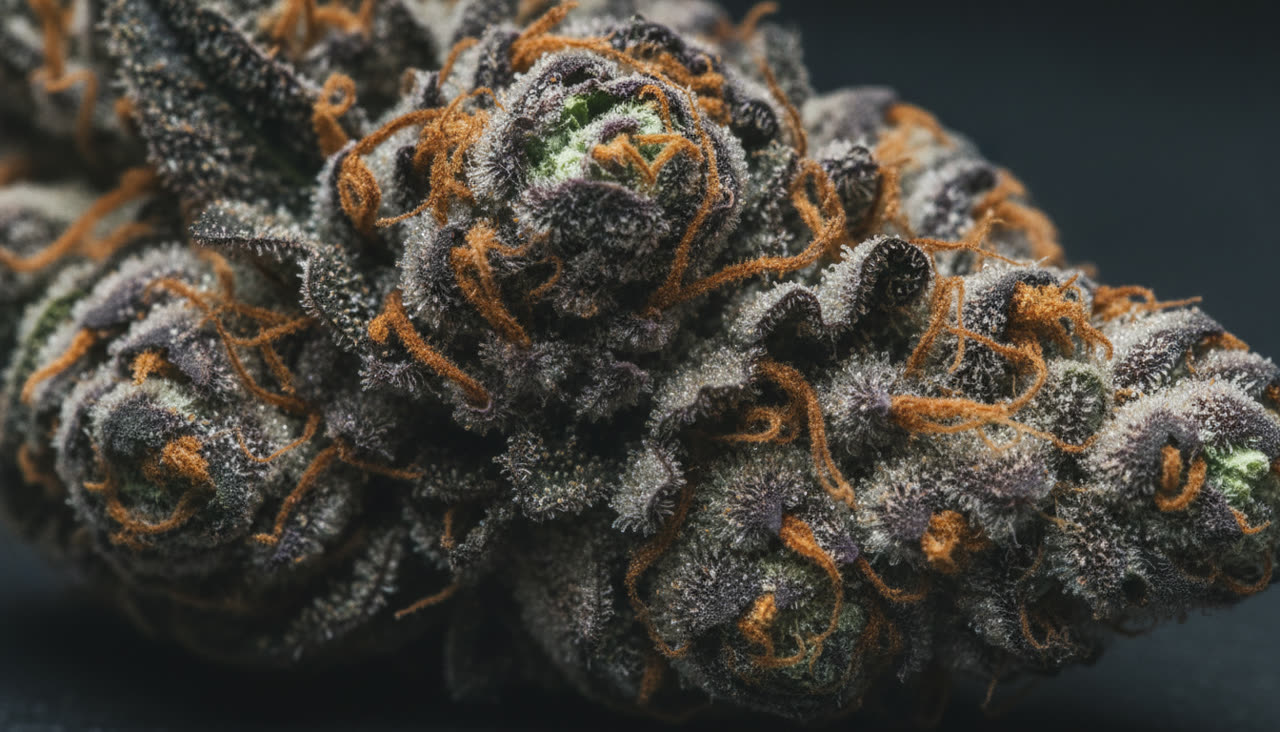
Every era of cannabis has its 'it' strain — the one that jumps the line at the dispensary, dominates the group chat, and somehow costs three times what the jar next to it does. In 2025 it was Blue Lobster. In 2026, one name has eclipsed them all: Toad — more precisely, Toad Venom — the most hyped, most debated, and most counterfeited cultivar in the game right now. Here's where it came from, why the whole industry is talking about it, and what the frenzy says about how cannabis culture actually works.
What Toad Venom actually is
Beneath the hype is a genuinely impressive plant. Toad Venom is an indica-leaning hybrid born from crossing Animal Face (from Seed Junky Genetics) with Sin Mintz — itself a cross of Sin Mint Cookies and Zkittlez. That lineage stacks dessert-gas royalty on both sides, and the result is exactly what connoisseurs chase: exceptional resin production, a complex candy-meets-fuel terpene profile, and potency that reviewers consistently clock in the high-20s to low-30s percent THC. In plain terms, it looks frosty, smells loud, and hits hard. If you want a primer on why those aromas matter more than the raw number, see our guide to what terpenes are and why THC percentage isn't everything.
The origin story — and the 'drama weed'
Here's where Toad gets interesting, because its backstory is half the product. The cross was bred, named, and marketed by Ronin Seeds of Los Angeles, whose co-owner — a former venture capitalist — specializes in building hype around scarce, closely held varieties. But the specific phenotype that became famous was selected by Green Dragon's Glen S., who reportedly popped all 30 Ronin seeds in 2021 and pulled a single standout he first called 'Becky.'
What followed is what the trade press memorably dubbed 'drama weed.' Ronin and Green Dragon both claim a piece of Toad's legend — Ronin bred and named it, Green Dragon selected the keeper — and the online feud over who 'owns' it, how the plant left the grow, and which cuts are 'real' has raged for four years. Counterfeits flood the market. Authenticity debates fill comment sections. And here's the twist: the drama is the marketing. Every argument about legitimacy is free advertising, and the scarcity it implies only drives the price higher.
The numbers are genuinely absurd
The hype shows up in dollars. On the illicit market, flower labeled 'Toad Venom' has reportedly fetched $120-$150 per eighth — double or triple top-shelf. Reports out of Thailand pegged it at $150 for 3.5 grams, roughly three times California top-shelf. Most eye-popping of all, Glen S. has described social-media posts offering $4,000 to $10,000 per pound on the East Coast, against perhaps $400 for a pound of California outdoor. Whether or not every figure holds up, the signal is unmistakable: a name on a label can now be worth more than the cannabis inside it.
Before Toad, there was Blue Lobster
Toad didn't appear in a vacuum. The strain it dethroned, Blue Lobster, ran the same playbook a beat earlier. A collaboration between Cipher Genetics (who bred the original Apples and Bananas × Eye Candy cross) and Maine Trees (who hunted, named, and popularized it), Blue Lobster was christened for the one-in-two-million rarity of a blue lobster in nature — a built-in story about exclusivity. It backed the narrative with hardware, sweeping Gassiest, Best Terps, and runner-up Best Overall at the 2023 East Coast Zalympix and landing a Leafly Strain of the Year nomination. When Maine Trees dropped it in New York and Los Angeles, dispensary staff couldn't keep it on the shelf. It even spawned a whole 'lobster family' — Pink Lobster, Grape Lobster — the way a hit song spawns remixes.
The blueprint: how a strain goes viral
Toad and Blue Lobster are following a template written years earlier by Runtz. Back at Emerald Cup 2017, the team behind Runtz showed up with about 300 jars, 2,500 branded t-shirts, and models, camped outside the Cookies booth, and sold out in minutes. The genetics were real, but the branding, scarcity, and spectacle were the rocket fuel. Co-signs from artists like Berner, Wiz Khalifa, and YG turned a strain into a lifestyle, and rap culture has driven the 'exotics' obsession ever since.
The modern hype machine adds social media. Photogenic, trichome-caked buds are built for Instagram and TikTok; 'zaza' reviewers, grow journals, and side-by-side comparison videos create endless engagement loops; and hashtags do the distribution. Layer in deliberate scarcity — limited drops, closely guarded cuts, waiting lists — and you manufacture demand. Analysts have noted a roughly 15% jump in demand for rare cultivars, driven by exactly this mix of social hype and limited availability.
What culture is really selling
Strip it down and the lesson is this: in 2026, a strain is a story as much as a plant. Genetics get you in the door — Toad and Blue Lobster are both legitimately excellent — but it's the narrative (a rare blue lobster, a four-year ownership feud, a $10,000 pound) that turns excellence into a phenomenon. Culture decides which great plants become legends, and right now culture has crowned the Toad.
What it means for New York's legal market
For New York consumers, the hype cuts two ways. The upside: the 'exotics' wave has raised the bar, pushing the state's craft growers toward louder terpenes, frostier flower, and the kind of dessert-gas genetics that made Toad famous. You can find that ambition in New York's own brands and our roundup of the best New York-grown cannabis brands.
The caution: where there's hype, there are counterfeits, and a viral name is no guarantee of quality or authenticity. The single biggest advantage of the licensed market is that every product is lab-tested and labeled — so a jar that claims to be Toad in a regulated shop comes with verifiable cannabinoid and terpene data, not just a hot name and a marked-up price. Chasing the hype on the gray market means paying legend prices for unverified flower. Instead, compare today's deals at licensed dispensaries, read the label, and let the test results — not the hashtags — decide whether it's worth it.
The bottom line
Toad Venom is the strain of the moment: real genetics, surreal prices, and a drama-fueled origin story that doubles as a marketing engine. It's the latest chapter in a tradition that runs from Runtz to Blue Lobster — proof that in modern cannabis, culture and story can be worth as much as the flower itself. Enjoy the hype, but shop it smart: buy licensed, read the lab results, and remember that the loudest name on the shelf isn't always the best smoke in the jar. For adults 21+. Educational and cultural commentary — not an endorsement, and prices and claims reported here reflect public reporting, not advice.