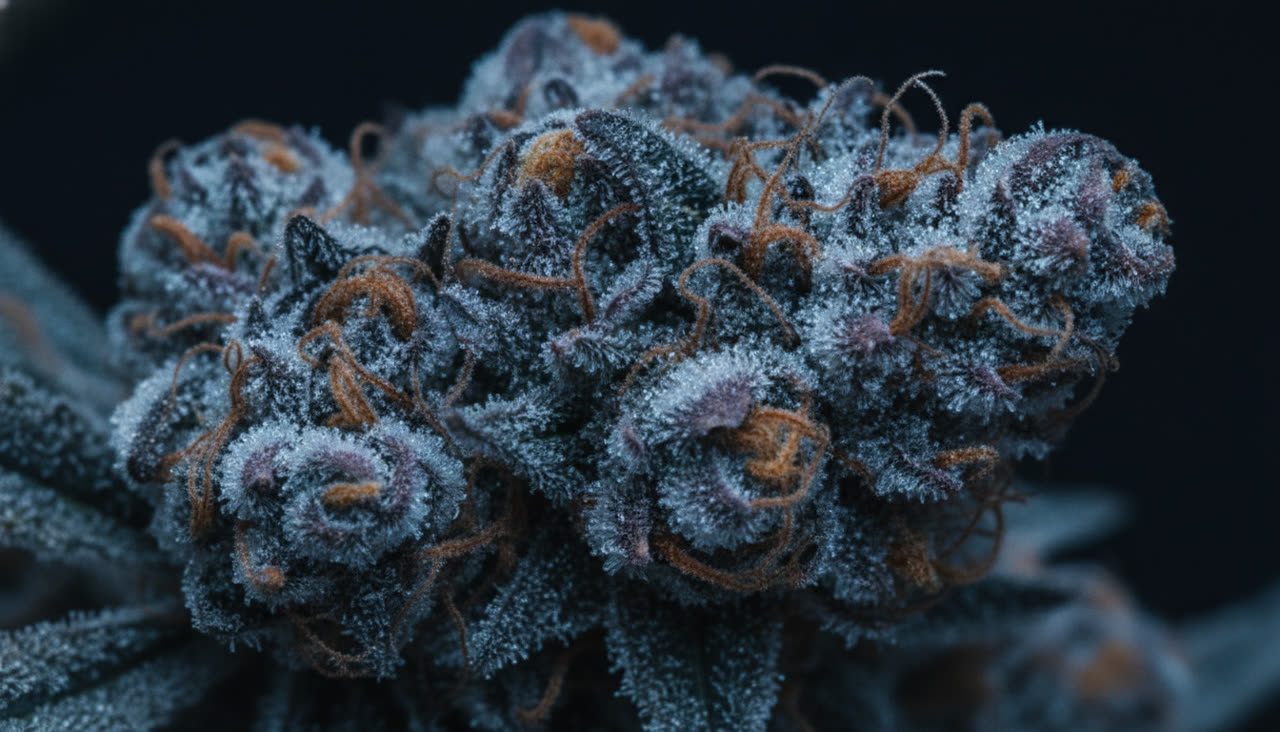
Before Toad Venom took the crown, the strain everyone on the East Coast was hunting had a stranger, more memorable name: Blue Lobster. Award-winning, perpetually sold out, and wrapped in a built-in story of rarity, it was the strain of the moment — and a perfect case study in how a modern cult favorite is made and how New York's exotics market really works.
The genetics and the name
Blue Lobster is an indica-leaning hybrid. The original cross — Apples and Bananas x Eye Candy — was bred by Cipher Genetics, while Maine Trees hunted the standout phenotype, named it, and popularized it. That two-step process — a breeder creates the cross, a brand finds and markets the special cut — is itself a hallmark of the modern exotics era.
The name is the masterstroke. A blue lobster occurs roughly one in two million in nature, so the strain arrived with a ready-made story about rarity and exclusivity. In the hype economy, a great name is half the battle — a lesson that traces straight back to Runtz. The genetics behind it are no accident either: Apples and Bananas is a fruity, gassy modern powerhouse, and its background ties into the same Gelato- and Cookies-rooted family tree that produced most of today's exotics.
Cannabinoid and terpene breakdown
Blue Lobster backs the name with real chemistry. While batches vary, a representative profile looks like this:
| Attribute | Typical range / profile |
|---|---|
| THC | ~25–30% |
| CBD | Low (under 1%) |
| Dominant terpenes | Caryophyllene, limonene, with gassy notes |
| Aroma | Heavy gas, candy fruit, sweet funk |
| Flavor | Gassy, fruity, dessert-sweet on the exhale |
| Bud appearance | Dense, frosty, colorful with blue/purple hues |
That terpene-forward, gas-heavy profile is exactly what East Coast connoisseurs chase — and a reminder that, as our guide explains, great terpenes matter more than a sky-high THC number.
Flavor, looks, and hardware
Blue Lobster isn't just a clever name — it has the awards to prove it. At the 2023 East Coast Zalympix it swept Gassiest, Best Terps, and runner-up for Best Overall, and it later earned a Leafly Strain of the Year nomination. In a market full of name-only hype strains, that hardware set it apart: judges in a competitive field singled out its gas-and-terpene profile as genuinely best-in-class.
Visually, the flower lives up to the billing — dense, frosty buds streaked with blue and purple, the rare case where a strain's look matches its name. The effect, as an indica-leaning hybrid, tends toward relaxing, body-forward calm with a euphoric lift up front, the kind of evening-leaning experience many exotics aim for.
The sell-out phenomenon
When Maine Trees dropped Blue Lobster in New York and Los Angeles, dispensary staff simply couldn't keep it on the shelf — every batch sold out. That scarcity became self-reinforcing: limited drops drove demand, demand drove hype, and hype drove the next limited drop. This is the engine of the modern exotics economy, and Blue Lobster ran it about as well as any strain has.
The strain even spawned a whole 'lobster family' — Pink Lobster, Grape Lobster — the way a hit record spawns sequels. Each new drop traded on the original's name recognition and aesthetic while offering a fresh flavor angle, keeping the brand alive on menus long after the first wave.
Why scarcity works
It's worth understanding the psychology, because it shapes how the whole New York exotics market behaves. Limited drops create urgency: if you don't buy this week, it's gone, and the next batch might not appear for months. That urgency turns ordinary flower into an event, and the resulting social-media buzz — photos of frosty buds, sold-out signs, lines at the counter — becomes free marketing that no advertising budget could buy. For a brand like Maine Trees, scarcity wasn't a supply problem to apologize for; it was the strategy. The lesson rippered outward, and today plenty of New York operators deliberately release small, hyped batches rather than flooding the shelf, which is why the savvy shopper learns to watch today's deals and drop calendars closely.
Where Blue Lobster fits in the exotics story
Blue Lobster is the bridge between Runtz and Toad in the story of modern exotics. Here's the lineage of hype it sits within:
| Era | Strain | What made it blow up |
|---|---|---|
| Mid-2010s | Runtz | Candy-gas genetics + LA branding |
| Early 2020s | Blue Lobster | Award sweeps + a one-in-two-million name |
| 2026 | Toad Venom | Scarcity + social-media frenzy |
It proved the Runtz playbook works on the East Coast — genuinely excellent genetics (the awards weren't an accident) wrapped in a great name, real scarcity, and regional hype — and set the stage for the Toad frenzy that followed. Understanding Blue Lobster is, in effect, understanding how the East Coast built its own exotics culture rather than just importing California's.
Finding it in New York
Blue Lobster and its lobster-family relatives surface on New York menus in limited drops — and the chase is part of the fun. Because the name carries so much cachet, it's also a prime target for counterfeiting in the illicit market, which is exactly why buying legally matters. A few tips:
- Buy from a licensed dispensaries so you're getting the real, lab-tested thing rather than a counterfeit riding the name.
- Compare today's deals on High Today, since limited drops can carry a premium that varies store to store.
- Browse New York brands to find similar gassy, dessert-fruit profiles when Blue Lobster sells out — which it usually does.
- Watch for terpene-forward New York exotics that scratch the same itch; the state's craft growers chase this style hard.
For the craft growers working this lane locally, see the best New York-grown brands and our look at the small craft growers worth knowing. New York's licensed market, overseen by the Office of Cannabis Management (cannabis.ny.gov), is where you'll find the verified, lab-tested versions of strains like this.
The bottom line
Blue Lobster had it all: award-winning genetics, an unforgettable name, and the scarcity to make it a cult obsession. It was the East Coast's strain of the moment — and a textbook example of how culture turns a great plant into a phenomenon. The hype may have moved on to Toad, but Blue Lobster's story remains one of the clearest windows into how modern cannabis really works. Educational only — not legal, medical, or financial advice. For adults 21+.