
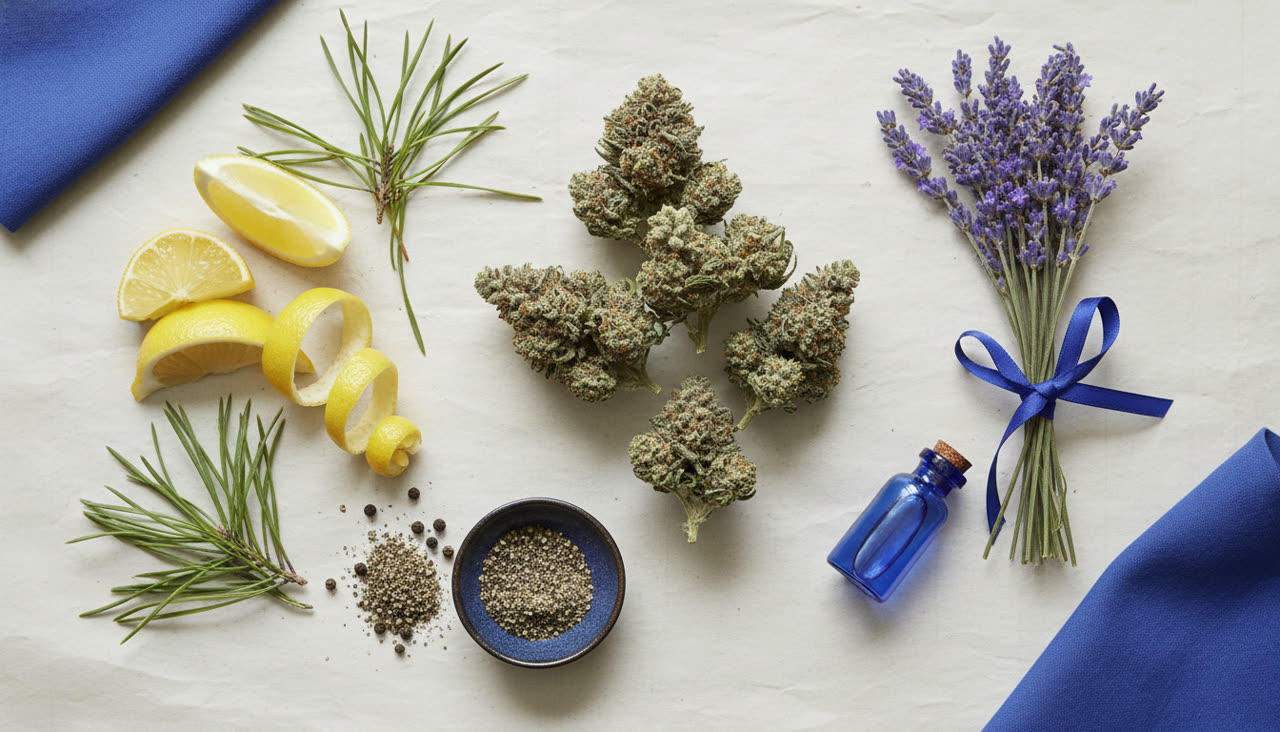
Open a jar of good cannabis and the first thing that hits you is the smell — sharp pine, bright citrus, diesel fuel, sweet berry, sometimes a whiff of lavender or black pepper. Those aromas aren't decoration. They come from terpenes, and learning to read them is one of the most useful skills a cannabis consumer can develop. In New York's licensed market, where labels increasingly list dominant terpenes alongside THC and CBD, knowing a handful of names turns a confusing wall of jars into an informed choice — and often a more enjoyable, more predictable high.
What terpenes are
Terpenes are aromatic compounds produced by cannabis and by plants everywhere — pine trees, citrus rinds, hops, lavender, black pepper. They are, in evolutionary terms, the plant's chemistry of self-defense and attraction: terpenes repel pests, deter grazing animals, and draw pollinators, all through scent. Cannabis happens to be extraordinarily rich in them, with well over a hundred identified so far, and they're responsible for the enormous range of aromas across different cultivars.
Crucially, terpenes are produced in the same sticky trichomes — the frosty, crystalline glands coating quality flower — that manufacture THC and CBD. That shared origin is why frosty, aromatic flower and a strong, characterful effect so often travel together. The trichomes are essentially tiny chemical factories, and the terpenes they pump out are believed to help shape the effect of a strain: not just how it smells, but how it feels in your body and head.
The terpenes worth knowing
You don't need a chemistry degree — just a short list of names. These are the ones you'll see most often on New York menus:
| Terpene | Aroma | Commonly associated with | Also found in |
|---|---|---|---|
| Myrcene | Earthy, musky, herbal | Relaxation, sedation | Mango, hops, thyme |
| Limonene | Bright citrus | Uplift, mood | Lemon and orange rinds |
| Caryophyllene | Peppery, spicy | Warmth, body | Black pepper, cloves |
| Pinene | Fresh pine | Alertness, clarity | Pine needles, rosemary |
| Linalool | Floral lavender | Calm | Lavender, coriander |
| Terpinolene | Fruity, herbal, complex | Brightness | Apples, nutmeg, lilac |
| Humulene | Earthy, hoppy | Grounding | Hops, sage |
Myrcene is the most abundant terpene in cannabis and the one most tied to that heavy, relaxed, couch-locked feeling — it dominates many classic indica-labeled cultivars. Limonene and terpinolene tend to show up in brighter, more energetic strains; the citrusy lift of a limonene-forward cut is one of the easiest profiles for beginners to recognize. Caryophyllene is notable for being the only terpene that also acts directly on the body's CB2 receptors, the same system cannabinoids engage, which is part of why it's associated with a warm, grounding, body-centered feel. Pinene brings a crisp, clear-headed quality, while linalool — the same compound that makes lavender smell like lavender — leans calming and floral.
A practical note: almost no cultivar is a single terpene. Real flower carries a blend, usually with two or three dominant players and a long tail of minor ones. The interplay of that blend is what gives each strain its signature.
Matching terpenes to the moment
Once you know the cast of characters, you can start matching profiles to what you actually want from a session. Reaching for daytime focus or a social afternoon? Look for limonene and pinene, the bright, citrusy, pine-forward terpenes that tend to track with more clear-headed, energetic flower. Winding down for the evening or chasing sleep? Myrcene and linalool lean relaxing and sedating. Want something warm and grounding without being knocked out? Caryophyllene-forward cuts often hit that note. None of this is a guarantee — the full chemistry, your tolerance, and your own body all play a role — but as a starting framework it beats picking a jar at random, and it's far more reliable than the indica/sativa shorthand alone.
Why terpenes beat the indica/sativa label
Here's the practical payoff. The indica/sativa label is a rough lineage map, but a strain's terpene profile is a far better predictor of how it will actually feel. As we explain in our guide to what the indica, sativa, and hybrid labels actually mean, two 'indicas' with different dominant terpenes can land completely differently. A myrcene-heavy 'sativa' can be more sedating than a terpinolene-forward 'indica.' Terpenes don't get you high on their own — that's THC's job — but as part of the entourage effect, they steer the character of the experience. Think of THC as the engine and terpenes as the steering wheel.
This is also why THC percentage isn't the whole story. A 22% flower with a rich, layered terpene profile often delivers a more enjoyable, more nuanced high than a flat 30% flower bred only for potency. Many of the celebrated modern exotics — from Runtz to Gelato — earned their reputations on flavor and terpene complexity, not on chart-topping THC numbers.
How terpenes change with handling
Terpenes are volatile — they evaporate and degrade with heat, light, oxygen, and time. That's why properly stored flower keeps its punch and stale flower smells flat, like dry hay. A jar left open on a sunny windowsill can lose much of its aroma within weeks. It's also why solventless extracts like live rosin and live resin are prized: freezing the plant fresh and using gentle, low-heat processing preserves the most fragile terpenes that harsher methods burn off. If you want to protect what you buy, our guide on how to store cannabis so it stays fresh covers the basics — cool, dark, airtight, away from heat, ideally with humidity control. Treat terpenes like a fine spice: they fade, so buy fresh and store smart.
This volatility also matters at the moment of consumption. Lower-temperature vaporizing preserves and showcases delicate terpenes, while high-heat combustion burns many of them away — one reason vaporizer enthusiasts talk so much about precise temperature control.
Shopping by terpene in New York
Many licensed New York products list their dominant terpenes right on the label or certificate of analysis. Once you notice that, say, limonene-forward strains tend to suit you, you can chase that profile instead of guessing. A few quick tips:
- Note your favorites. After a session you enjoyed, check which terpene led the profile and write it down. A short notes file beats memory.
- Ask for recommendations by terpene, not just 'something strong' — budtenders at licensed dispensaries increasingly think this way and can point you to matching cultivars across formats.
- Compare today's deals on High Today once you've found your lane, and browse New York brands known for terpene-forward flower and solventless extracts.
- Look for total terpene percentage when listed — anything above roughly 2% is considered aromatic and flavorful, and the very best craft flower can push 3% or higher.
- Trust your nose. If a jar is sealed, the budtender can often tell you what it smells like. The aromas you're naturally drawn to are usually a good guide to what you'll enjoy.
New York's testing and labeling standards, overseen by the state Office of Cannabis Management (cannabis.ny.gov), are part of what makes shopping by terpene possible here — the data is on the label because the law requires lab verification.
The bottom line
Terpenes are the aroma — and a big part of the experience. Learn a handful of names, pay attention to which ones you enjoy, and shop by profile alongside THC and CBD. It's the fastest path from random results to consistent ones, and it'll make you a sharper, happier shopper at any New York dispensary. Educational only — not legal, medical, or financial advice. For adults 21+.