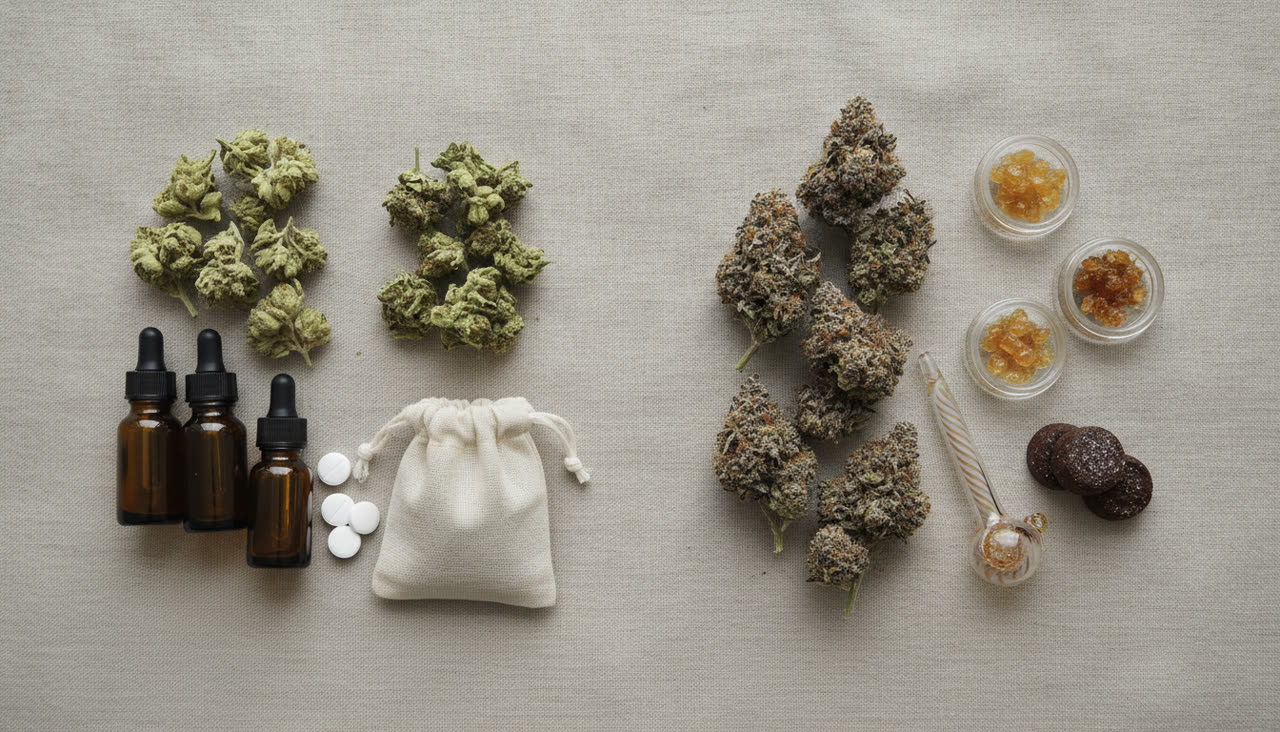
If you only learn two words before your first dispensary visit, make them THC and CBD. These are the two most important compounds in cannabis, they come from the same plant, and they are constantly confused — yet understanding the difference between them is the single fastest way to shop with confidence instead of guessing. This guide breaks down what each one does, why only one gets you high, how the two work together, and how to use that knowledge to pick the right product.
The one-sentence version
THC is the compound that gets you high; CBD is the one that doesn't. That's the core distinction, and almost everything else flows from it. THC (tetrahydrocannabinol) is responsible for the euphoria, the head-and-body effects, and the impairment people associate with cannabis. CBD (cannabidiol) is non-intoxicating — it can promote a sense of calm or balance, but on its own it won't make you feel high.
What THC does
THC is the headliner. It binds directly to receptors in the body's endocannabinoid system — a network of receptors that helps regulate mood, appetite, pain, and more — and that binding produces the classic high: euphoria, altered perception, relaxation, hunger, and, at higher doses, the heavier or more sedating effects. THC is what determines a product's potency in the sense most people care about, which is also why a higher THC percentage isn't always better: more THC means a stronger high, not necessarily a better experience.
What CBD does
CBD interacts with the endocannabinoid system too, but more indirectly, and it doesn't produce intoxication. People reach for CBD when they want a calmer, clear-headed effect — something that takes the edge off without clouding the day. On its own, a CBD product is the opposite of a strong edible: you stay functional and unimpaired. Its most useful trick for cannabis consumers, though, is what it does alongside THC.
How they work together: the entourage effect
This is where it gets practical. CBD and THC are often combined in deliberate ratios, and CBD has a balancing influence: it can soften or round off the intensity of THC, making a product feel gentler and more manageable. That interaction is part of the broader entourage effect — the idea that cannabis compounds work better together than in isolation. For a beginner, a product with meaningful CBD next to its THC is often a friendlier introduction than a THC-only product of the same strength.
Reading ratios on the label
New York's lab-tested products list cannabinoid amounts in milligrams, and many are sold as ratios:
| Ratio (CBD:THC) | What to expect | Good for |
|---|---|---|
| 1:1 | Balanced, milder, clear-headed | Beginners, daytime, easing in |
| High-CBD (e.g. 20:1) | Very little to no high | Calm without impairment |
| THC-dominant | Stronger, classic high | Experienced users, stronger effect |
Learning to read these is part of reading a dispensary label in general. The milligram numbers — not vague terms — are what tell you how a product will actually feel.
A closer look at the endocannabinoid system
To really understand why these two compounds behave so differently, it helps to know what they're acting on. Your body has an endocannabinoid system (ECS) — a network of receptors (the main two are called CB1 and CB2) and naturally occurring 'endocannabinoids' that helps keep things in balance: mood, appetite, sleep, pain signaling, and more. THC works largely by binding directly to CB1 receptors, which are concentrated in the brain — and that direct binding is what produces intoxication. CBD barely binds to those receptors at all; instead it influences the system more indirectly, which is a big part of why it doesn't get you high. Same plant, two completely different mechanisms — that's the whole story in one paragraph.
Where each compound comes from
Both THC and CBD start as CBGA ('the mother cannabinoid') in the living plant and are shaped by the plant's genetics into THC-dominant, CBD-dominant, or balanced chemotypes. Neither is active in the form the plant produces, though — raw cannabis contains THCA and CBDA, the acidic precursors, which only convert to THC and CBD when heated. That conversion (decarboxylation) is why you can't get high from eating raw flower and why edibles use cannabis that's been heated first. It's a useful reminder that the cannabinoids on your label are the activated versions.
Common myths, cleared up
- 'CBD is the medical one and THC is the recreational one.' Too simple. THC has well-documented effects people value, and CBD is used recreationally for calm. They're tools, not moral categories.
- 'CBD cancels out THC.' It doesn't cancel it — it can moderate or round off the experience, but a CBD-and-THC product will still get you high if there's enough THC.
- 'More CBD is always better.' Not necessarily. The right amount depends entirely on the effect you want; sometimes a little THC is exactly the point.
- 'CBD does nothing.' Many people find genuine value in it; it just doesn't announce itself with a high, so the effects are subtler and easy to overlook.
Beyond THC and CBD: the supporting cast
THC and CBD get top billing, but they share the stage. CBN is a mildly sedating cannabinoid often added to sleep products; CBG is a non-intoxicating 'minor' cannabinoid gaining attention; and terpenes — the aromatic compounds covered in our terpene guide — shape the character of an experience as much as the cannabinoids do. This teamwork is the entourage effect, and it's why two products with identical THC can feel different. Once you're comfortable with THC vs. CBD, these are the next layer worth learning.
How to shop with this knowledge
Decide what you want first. If you want to feel a classic high, you're shopping for THC — start with a low dose and go slow, and remember that a higher THC number isn't automatically better. If you want calm without impairment, you're shopping for CBD or a high-CBD ratio. If you want something in between, a balanced 1:1 is the sweet spot many people return to, and it's a friendly starting point if it's your first time. Whatever you choose, buy lab-tested products from a licensed dispensary so the numbers on the label are real, and compare options and deals before you buy.
The bottom line
THC gets you high; CBD doesn't; and together they let you fine-tune the experience. Once you understand that, the wall of products at a dispensary stops being intimidating and starts being a menu you can actually read. Start low, favor balanced ratios while you learn your tolerance, and let the milligrams — not the marketing — guide you. Educational only — not legal, medical, or financial advice. For adults 21+.